BACK TO TOP

Mostrando entradas con la etiqueta biofuels. Mostrar todas las entradas

miércoles, 27 de febrero de 2013

AFRICA IN THE SUPERMARKET CART

By Gundhramns Hammer
February 27, 2013

Source: CIAT Blogs
 

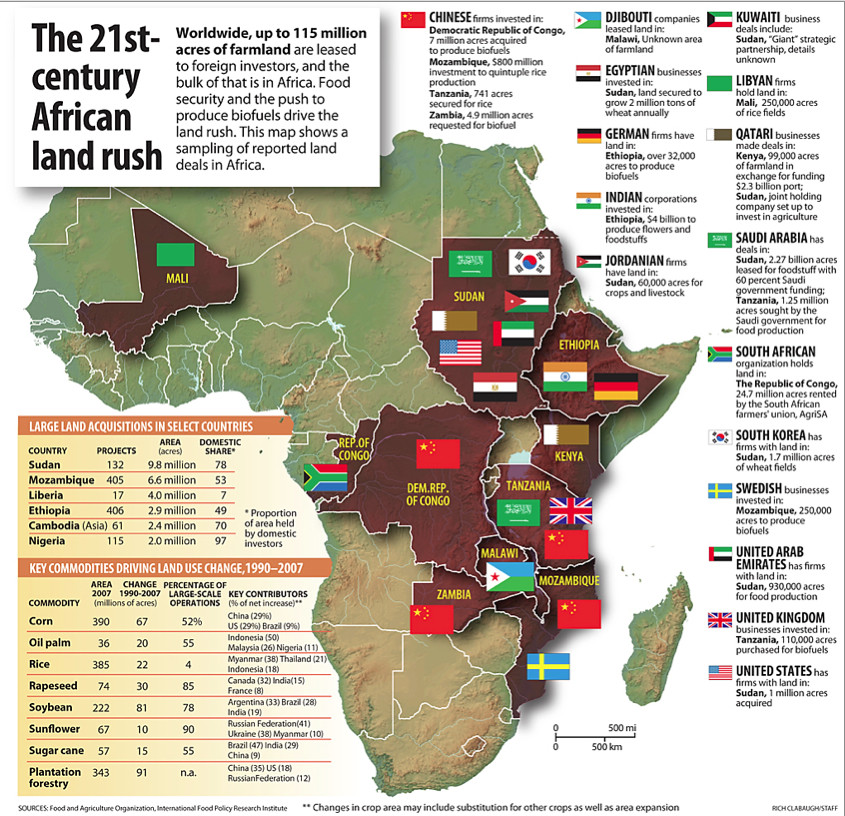
Africa is for sale to the highest bidder. Many foreign investors (Saudi Arabia, Germany, Sweden, India, South Korea, Jordan, China, some US universities and corporations, etc.) are buying and/or leasing land in Africa. At the root of this land grabbing is food security and the quest for biofuels.

Those African governments involved in these deals show no transparency and no concern for their country fellowmen. They are only interested in their own pockets and having a bank account in Switzerland or in any other tax haven notwithstanding they claim it is done to get funds for local development. As usual the foreign investors promise jobs and development projects which are never delivered or if they do so is only a few crumbs.

In the end, poor African families are kicked out of their ancestral lands with no compensation and end up poorer. The rich get richer. And the consumers in the so called "developed" nations get what they want at the supermarkets or at the gas stations. 
 
But not only people suffer because of these foreign land investments in Africa (Cameroon, Ethiopia, Mali, Mozambique, Sierra Leone, South Sudan, Tanzania, Zambia). Forests are cleared (Fig. 1) to make room for soybean crops, sugar cane fields or any plantation done for profit. Such projects are portrayed as "sustainable development" outside Afica in the media.
 
 
Figure 1. Massive deforestation in Cameroon. Source: The Oakland Institute (2012).
 
 
These shortsighted projects cause deforestation, soil erosion and wildlife extinction. Biodiversity is destroyed and replaced by monocultures (Fig. 2) and massive used of pesticides and herbicides poisoning the soil and water resources.
 
 
Figure 2. Monocultures in Zambia. Fuente: The Oakland Institute (2011).


All of this makes no ecological sense. Shortsightedness results in Nature shorcircuiting and hitting right in the ass of a species that brags about being so sapiens in the long run.
 
The consumption demands of the consumers in the rich nations or those from wealthy people in the poor nations are obviously at the gist of this matter. What they ask for is given to them by the shepherds of the flocks. 
 
So watch out and be careful with what you consume or buy so that when you push the gas pedal of your car or shop for some luxury or food item (fish, meat, etc.) that come out of Africa, you do not squeeze or choke up an African child directly with your hands but indirectly yes, with a very long rope reaching way beyond your own home
 
After all, everything is connected on this beautiful planet we call Earth, be it ecological systems of Nature or in the economical schemes set up by this biped naked ape (Homo sapiens). The former supporting the latter.

What it is really sad is that man by chasing economical dreams of power has been empowered not to solve problems which he should but to resolve the equation of his own destruction in the end
 
He has to back to school and learn that: Economics + screwed up ecology = self-destruction. The sooner he learns this the better if he wants to survive.

Nature will teach him hard lessons if he does not pay attention at the School of Life. So far he has not.  
 
He must remember that Mother Nature, the Teacher, is very patient but when she gets tired she strikes right and left and up and down. And down the drain humankind could go to join the labyrinthodonts for being so haughty and deaf.
 
His latest assault upon his brethren in Africa leaves him standing as an idiot in the long run, for what sounds like money today, tomorrow will sound as death and pain caused by political restlessness and dispair which will eventually reach his doorstep and knock at his door. Should he open or not his door, the pestilence will get in his abode and shake his bed and sleep in peace no more.
 
Let us see what is happening in a flow sequence:

                                          
   FOREIGN INVESTORS
 
Source: Aljazeera
                                                             
Source: Country Scents

                                                              
CORN
OIL PALM
RAPESEED
SOYBEAN
SUNFLOWER
SUGAR CANE
JATROPHA
PLANTATION FORESTRY
ETC.


Source: income strategies blog
THE RESULT AT THE END 

1. A LOT OF PEOPLE GET POORER IN AFRICA

Source: theguardian


Source: ahmedbashu3.blogspot.com


AND 

2. A FEW PEOPLE GET RICHER IN AND OUT OF AFRICA


Source: EMPOWER NETWORK


So where does man put his sapiens before or after he is name? Wherever he puts it, does he deserve it? In spite of all of his cultural paraphernalia he still is quite insapiens.


References

The Oakland Institute (2011). Understanding Land Investment Deals in Africa. Country Report: Zambia. OI, Oakland, CA, USA. 54 p.

lunes, 4 de febrero de 2013

SYNTHETIC BIOLOGY: THE DEVIL IS IN THE FINANCIAL DETAILS

Oil companies’ significant investments have made biofuels the mainstay of R&D.

© Orlando Florin Rosu - Fotolia.com


    In an appearance March 10 on Comedy Central's "The Colbert Report," Jay D. Keasling, Ph.D., chemical and biomolecular engineering professor at UC Berkeley, explained how he and his colleagues at the Joint BioEnergy Institute were persuading yeast to make ethanol instead of alcohol from sugar. In response to host Stephen Colbert's suggestion that he was (and is) a mad scientist, Dr. Keasling replied that the same yeast that we use to produce beer and bread will soon be fueling our cars and planes. 

    The last laugh is definitely on Colbert, as Dr. Keasling’s synthetic biology company Amyris has developed fuels with properties superior to those of existing renewable alternatives. In 2009, the company announced that the EPA had obtained its No Compromise™ diesel fuel, making it the first hydrocarbon-based fuel made from plant-derived resources to be registered for commercial sale.

    Amyris also developed a semisynthetic form of artemisinin, a key ingredient in first-line malaria treatments, in a project funded by a grant from the Bill and Melinda Gates foundation. Amyris, however, handed over a royalty-free license to this technology to sanofi-aventis for the manufacture and commercialization of artemisinin-based drugs with a goal of market availability by 2012.

    Technological advances and huge investments have fueled this segment, which has the potential to reach $2.4 billion by 2013. A lion’s share of the money has come from oil companies. Amyris and other synthetic biology enterprises like Synthetic Genomics (SGI) have thus focused on producing alternative fuels despite first products that were potential pharmaceuticals. Both Amyris’ and Synthetic Genomics’ deal-making activities reflect those investments, as does the industry’s current leadership.

    Following the Money


    James Collins, Ph.D., a professor of biomedical engineering at Boston University and a Howard Hughes Medical Institute investigator told GEN that alternative fuels has become the “killer app” for synthetic biology. The good news was that they brought attention to the field and a lot of funding into it. The bad news was that biofuels detracted the focus from other fields like new therapeutics development. “In my view, the amount of money thrown at alternative fuels resulted in recruitment of a majority of talented scientists into bioenergy at a critical time for the field.”

    Amyris was founded in 2003 and has since raised more than $244 million in private funding including $138.6 million on June 23, 2010. Its first CEO, John G. Melo, was previously president of U.S. fuels for BP. The firm says that it has about six corporate partnerships including one that resulted in an affiliate of French oil and gas giant Total SA becoming its largest stockholder.

    SGI was founded in 2005 by J. Craig Venter, Ph.D., Hamilton Smith, M.D., who shared the Nobel Prize in 1978 for physiology or medicine, Juan Enriquez, and David Kiernan. In 2007, BP reportedly made a substantial equity investment in the company as part of a R&D deal. Synthetic Genomics was to study the gene sequences of microbes that live within hydrocarbons and develop biological conversion processes that could lead to cleaner energy production and improved recovery rates. In retrospect, the deal should have focused on oil-eating, not fuel-making, microbes.

    Exxon Mobil made its first major investment in greenhouse gas reducing biofuels in 2009 via a $600 million partnership also with Synthetic Genomics to develop transportation fuels from algae. And technology companies wanting broader franchises in synthetic biology have been putting money into SGI, the latest being Life Technologies. On June 2, Life Technologies said that it had made an equity investment in SGI.

    About two months before inking the deal with SGI, Life Technologies purchased about 59% of Germany’s Geneart, which concentrates on DNA engineering and processing. It provides custom gene-synthesis and gene-optimization services to its customers. Life Technologies now owns a 74% stake in that company.

    The SGI investment, in particular, extends Life Technologies footprint beyond tools and services to the basic science behind creating synthetic life forms. Peter Dansky, Life Technologies’ president of molecular biology systems, told GEN that the move reflects the company’s openness to expanding its business model. “It’s pretty unlikely we’ll be setting up biofuel pumps, but we think there are significant evolving spaces for applications that we can play in.

    “We’ve typically been a research tool oriented company, so why are we making investments beyond the tool stage? First of all, our roots are in research but our mission is to apply life sciences to improve human conditions. An example of this in the medical world is molecular diagnostics. Our tools are increasingly applied in molecular diagnostics, and we think this analogy holds in synthetic biology.”

    Dansky noted that the firm’s investment in SGI speaks to where Life Technologies believes there’s an opportunity. “Our interest is being on the leading edge and in touch with thought leaders.  It’s not about their business model.”

    Will Good Science Prevail?


    Governments as well as private industry have also increased investments in synthetic biology. The Woodrow Wilson Center’s Synthetic Biology Project found that the U.S. government has spent around $430 million on research related to synthetic biology since 2005, with the Department of Energy funding a majority of the research. By comparison, the analysis indicated that the EU and three individual European countries—The Netherlands, U.K., and Germany—spent approximately $160 million during the same period.

    And the reality of fuel factory microbes may be somewhat closer to realization with the J. Craig Venter Institute (JCVI) reporting in May that it had created a synthetic organism. The project consumed $40 million, a team of 20 people, and about 12 years to complete. SGI has provided JCVI with nearly $30 million in funding since 2005.

    Dr. Venter and his team reported that they had assembled a 1.08 mega base pair Mycoplasma mycoides JCVI-syn1.0 genome using digitized genome sequence information. The scientists transplanted the genome into a M. capricolum recipient cell to create new M. mycoides cells controlled only by the synthetic chromosome.

    Is the bug that Dr. Venter built a parlor trick or a real technological road map for producing worker bee bacteria that can provide new drugs, sources for scarce drugs, safer fuels, and address the messes made by oil companies? Plenty of skeptics, while thoroughly impressed with the remarkable technical achievement in producing the new organism, have raised some practical issues. One significant issue remains the unpredictable results of introducing either novel genetic sequences or whole new genomes into non-native hosts.

    The new bacterial cell, nicknamed Synthia, certainly focused the President’s and Congress’ attention on synthetic bio. President Obama, almost immediately following the JCVI’s announcement, called for the Presidential Commission for the Study of Bioethical Issues to “undertake, as its first order of business, a study of the implications of this scientific milestone to identify appropriate ethical boundaries and minimize possible risks associated with the breakthrough.” The committee is expected to deliver a report within about four months.

    Ultimately, it is hoped that calm heads and good science will prevail over the sort of fear-mongering stuff that appeared for example, in a June 3 online edition of the Daily Mail, that seems to have created its own artificial life forms with the headline “Scientist Accused of Playing God After Creating Artificial Life by Making Designer Microbe from Scratch—But Could It Wipe Out Humanity?” How many wrong ideas could you pack into one headline?
Source: 
GEN Genetic Engineering & Biotechnology News
Link: 
http://genengnews.com/analysis-and-insight/b-synthetic-biology-b-the-devil-is-in-the-financial-b-details-b/77899331/