BACK TO TOP

sábado, 8 de junio de 2013

FRACKING FOR SHALE NATURAL GAS AND OIL: MAN´S FAILURE IN THE UPKEEP OF HIS OWN NEST

By Hugo M. G. von Österreich und von Toskana
Member of the Union of Concerned Scientists (USA)
June 8, 2013


Source: Los Angeles Times.


Hydraulic fracturing (Fig. 1) has been around for some time. This technology was developed in the 1940s and is used to produce spaces in the rock pores deep underground to release natural gas and oil so they can be tapped to the surface.


Figure 1. Hydraulic fracturing. Source: American Petroleum Institute.


Franco et al. (2013) describe a fracking operation as follows (Video 1):

"A typical unconventional gas frac involves drilling down three to six kilometres into the earth, beneath underground fresh water sources. When the shale or coal bed geological formations are reached, the drilling then proceeds horizontally for up to two kilometres in order to capture more gas. This horizontal borehole is filled with small packages of ball-bearing-like shrapnel and light explosives. The packages are detonated, and the shrapnel pierces the borehole opening up small perforations in the rock. A series of fractures, between 10 to 20, are created at set intervals about every 100 meters along the horizontal borehole. Furthermore, each drilling site, or pad, can host several horizontal wells – known as multi-well pads."


                                             Video 1. Hydraulic fracturing 3D animation.


To achieve the fracking, a mixture of water, sand and chemical additives (Fig. 2, Table 1), the fracturing or pumping fluids, are injected under high pressure into the shale or fuel formation layer underground to produce fissures or fractures in the rock which will allow the gas or oil to flow freely to the surface.


Figure 2. Typical shale fracturing and chemical additives used in fracturing water. Source: American Petroleum Institute.


Table 1. Chemicals Used in the Hydraulic Fracturing Process in Pennsylvania (USA). Source: Marcellus Drlling News.
Chemical Product Name
2,2-Dibromo-3-Nitrilopropionamide Bio Clear 1000/Bio Clear 2000/ Bio-Clear 200/BioRid20L/ EC6116A
2-methyl-4-isothiazolin-3-one X-Cide 207
5-chloro-2-methyl-4-isothiazolin-3-one X-Cide 207
Acetic Acid Fe-1A Acidizing Composition/ Packer Inhibitor
Acetic Anhydride Fe-1A Acidizing Composition
Acetylene GT&S Inc./ Airco
Alcohol Ethoxylated C12-16 NE-200
Alkyl benzene sulfonic acid Tetrolite AW0007/ FR-46
Ammonia (aqueous) FAW-5
Ammonium Bifluoride ABF 37%
Ammonium Persulfate AP Break
Ammonium Bisulfite Techni-Hib 604/ Fe OXCLEAR/ Packer Inhibitor
Ammonium chloride Salt Inhibitor
Ammonium Salt (alkylpolyether sulfate) Tetrolite AW0007
Amorphous silica TerraProp Plus/ Bituminous Coal Fly Ash ASTM C618
Benzoic Acid Benzoic Acid
Boric Acid BC-140/ Unilink 8.5
Boric Oxide XLW-32
Calcium Chloride Dowflake
Calcium Oxide Bituminous Coal Fly Ash ASTM C618
carboxymethylhydroxypropyl guar blend Unigel CMPHG
Choline Chloride Clay Treat-2C
Cinnamaldehyde ENVIROHIB 2001
Citric Acid Ferrotrol 300L/ IC-100L
Complex polyamine salt Clay Master-5C
Crystalline Silica: Cristobalite
Crystalline Silica: Quartz Silica Sand/ / Atlas PRC/ Best Sand/ Bituminous Coal Fly Ash ASTM C618
Cupric chloride dihydrate Ferrotrol 280L
Cured resin LiteProp 125
Cyclohexanes CS-2
Dazomet ICI-3240
Diethylene Glycol Scaletrol 720/ Scaletrol 7208
d-Limonene
MA-844W
Enzyme GBL-8X
EO-C7-9-iso-, C8 rich-alcohols NE-940/ NE-90
EO-C9-11-iso-, C10-rich alcohols NE-940/ NE-90
Ethoxylated Alcohol FRW-14/ SAS-2/ Flomax 50/ WFR-3B
Ethyl Acetate Castle Thrust
Ethyl Alcohol FAW-5/ Castle Shop Solv/ Dallas Morris
Ethylbenzene NDL-100/ PARANOX/ Uniflo II
Ethylene Glycol ENVIROHIB 2001/ ICA-2/ LEB 10X/ Scaletrol
720/ Sceletrol 7208/ CC 300/ Clachek A/ Clachek
LP/ Ironsta II B/ NCL-100/ BC 140/ NCL-100/
Flomax 50/ NCL/ Scalehib 100/ Unihib O/ Unilink 8.5
Formic Acid ENVIROHIB 2001
Gluconic Acid Interstate ICA-2
Glutaraldehyde Alpha 114/Alpha 125/ ICI-150
Glycerol Bio Sealers
Glycol Ethers ENVIROHIB 2001/AMPHOAM 75/ PARANOX/ Uniflo II/ Unifoam/ WNE-342LN
Guar Gum PROGUM 19 GUAR PRODUCT/ Unigel 19XL/ Benchmark Polymer 3400/ WGA-15/ Unigel 5F
Hydrochloric Acid Hydrochloric Acid (HCL)/ TETRAClean 542/ Muriatic Acid
Hydrochloric Acid 3% – 35% Hydrochloric Acid 3% – 35%
Isopropanol AFS 30 Blend/ FAC-1W/ FAC-3W/ MA-844W/ NE-23/ NE-940/ Flomax 50/ Tetrolite AW0007/
FMW25 Foamer/ CS-2
Isopropyl Alcohol NFS-102/ WFT-9511/ LT-32/ AR-1/ Flomax 50/ NDL-100/ Unibac/ Uniflo II/ Uniflo/ Unihib O/
WNE-342LN
Methanol
AFS 30 Blend/ NE-200/ Activator Superset-W/ CI-14/ FAW-5/ GasFlo/ Inflo-250W/ LT-32/ NE-940/
XLW-32/ Tetrolite AW0007/ FMW25 Foamer/ 40 HTL Corrosion Inhibitor/ NE 100/ HAI-OS Acid
Inhibitor/ Unibac/ NE-90/ Packer Inhibitor
Methyl Alcohol Clearbreak 400/ Super Surf/ Castle Shop Solv
Methyl Salicylate Bio Sealers
n-butanol AirFoam 311
Nitrilotriacetamide Salt Inhibitor
Phenolic Resin Atlas PRC
Polyethylene Glycol NE-940/ EC6116A/ NE-90
Polyethylene Glycol Mixture Bio Clear 2000/ Bio-Clear 200
Polyoxylalkylene sulfate FMW25 Foamer
Polysaccharide Blend GW-3LDF
Potassium Carbonate BF-7L
Potassium Chloride Dowflake
Potassium Hydroxide B-9, pH Increase Buffer/ BXL-2
Propargyl Alcohol CI-14/ HAI-OS Acid Inhibitor
Propylene Glycol SAS-2/ WFR-3B
Silica S-8C, Sand, 100 mesh/ Montmorillnonite clay
Sodium Bicarbonate K-34
Sodium Bromide BioRid 20L
Sodium Hydroxide Caustic Soda/ ICI-3240/ BioRid B-71
Sodium Persulphate High Perm SW-LB
Sodium Xylene Sulfonate FAC-2/ FAC-3W
Sulfuric Acid Sulfuric Acid
Surfactants AFS-30/ GasFlo/ Inflo-250W
Talc Adomite Aqua
Tetrakis(hydroxymethyl)phosphonium sulfate Magnacide 575 Microbiocide
Tetramethyl ammonium Chloride Clay Treat-3C
Trimethyloctadecylammonium chloride FAC-1W/ FAC-3W


Right away we can see that, although billions of natural gas and oil can be produced, this technology is not 100% environmentally safe as we are told, for it has its drawbacks. Three major potential dangers may occur whilst fracking for natural gas and oil:


Furthermore, fracking means water depletion. It uses too much water from the aquifers in the process of extraction of the energy resources. 

Fresh water that as we go deep into the future will become scarcer and scarcer to man´s chagrin and a terrible loss for everyone whose lives depend on this priceless resource.

The region where the fracturing technology is applied is plagued with hundreds of drill holes and bare soil patches when seen from the sky (Fig. 3).

Figure 3. Fracking in Wyoming (USA). Source: The Equation.


The mess left behind or the patching to remedy its impact if ever done is nothing but a constant reminder of man´s quest to quench his senseless addiction to energy, which it is normally employed to continue one way or another the destruction of the Biosphere with his pointless and rather useless activities that in the end add up to nothingness, and also shows his little respect for the environment in the overall picture of life on planet Earth. 


All of this search for energy is ridiculous and counterproducing in the long run. What man has to do is to learn to live within the planetary limits, consume less, lead a simpler life and get out of his crazyness of searching for a life full of abundance for a few privileged ones, people that notwithstanding their giant net of mechanical gadgetry cannot so often find satisfaction to their loneliness in a natural world from which they become more alienated with each passing day.


Man is a giant and yet smaller than an ant

Man is always pointing and searching in a direction that in the short run it may appear to be right to follow if only guided by the economical compass. But in the long run, it usually turns sour and he ends up snared in his own sticky trap. 

Living is one thing but learning to live is another. Man is unarguably sapiens but wise is another story. He is still far from being that. His record of Nature destruction around the world speaks by itself.

There are many lessons that man has yet to learn from his non-human brethren. He must learn to go along and not against Mother Nature.  

Man is now a giant in matters of science and technology over the entire Earth but he still is a dwarf smaller than an ant when it comes to dealing with the upkeep of his own nest.


References

American Petroleum Institute (API). (2010). Hydraulic Fracturing: Unlocking America´s Natural Gas Resources. Freeing Up Energy. API, Washington, DC, USA. 14 p. 

Franco J, Rey Martinez A. M. & Feodoroff T. (2013). Old Story, New Threat: Fracking and the Global Land Grab. Transnational Institute, Washington, DC, USA. 12 p. 

Green C. A. & Styles P. (2012). Preese Hall Shale Gas Fracturing: Review & Recommendations for Induced Seismic Mitigation. British Geological Survey, Natural Environment Research Council, UK. 26 p. 


Schafer D. D. (2012). Frack Attack: Cracking the Case Against Hydraulic Fracturing. Independence Institute, Denver, CO, USA. 32 p.

Sumi L. (2005). Our Drinking Water at Risk: What EPA and the Oil and Gas Industry Don´t Want Us to Know about Hydraulic Fracturing. Oil and Gas Accountability Project, Durango, CO, USA. 64 p.

lunes, 3 de junio de 2013

RUSSIA WARNS OBAMA: GLOBAL WAR OVER “BEE APOCALYPSE” COMING SOON

Source: What Does It Mean.com
View original

By: Sorcha Faal, and as reported to her Western Subscribers


The shocking minutes relating to President Putin’s meeting this past week with US Secretary of State John Kerry reveal the Russian leaders “extreme outrage” over the Obama regimes continued protection of global seed and plant bio-genetic giants Syngenta and Monsanto in the face of a growing “bee apocalypse” that the Kremlin warns “will most certainly” lead to world war. 

According to these minutes, released in the Kremlin today by the Ministry of Natural Resources and Environment of the Russian Federation (MNRE), Putin was so incensed over the Obama regimes refusal to discuss this grave matter that he refused for three hours to even meet with Kerry, who had traveled to Moscow on a scheduled diplomatic mission, but then relented so as to not cause an even greater rift between these two nations. 

At the center of this dispute between Russia and the US, this MNRE report says, is the “undisputed evidence” that a class of neuro-active insecticides chemically related to nicotine, known as neonicotinoids, are destroying our planets bee population, and which if left unchecked could destroy our world’s ability to grow enough food to feed its population. 

So grave has this situation become, the MNRE reports, the full European Commission (EC) this past week instituted a two-year precautionary ban (set to begin on 1 December 2013) on these “bee killing” pesticides following the lead of Switzerland, France, Italy, Russia, Slovenia and Ukraine, all of whom had previously banned these most dangerous of genetically altered organisms from being used on the continent.  

Two of the most feared neonicotinoids being banned are Actara and Cruiser made by the Swiss global bio-tech seed and pesticide giant Syngenta AG which employs over 26,000 people in over 90 countries and ranks third in total global sales in the commercial agricultural seeds market.

Important to note, this report says, is that Syngenta, along with bio-tech giants Monsanto, Bayer, Dow and DuPont, now control nearly 100% of the global market for genetically modified pesticides, plants and seeds. 

Also to note about Syngenta, this report continues, is that in 2012 it was criminally charged in Germany for concealing the fact that its genetically modified corn killed cattle, and settled a class-action lawsuit in the US for $105 million after it was discovered they had contaminated the drinking supply of some 52 million Americans in more than 2,000 water districts with its “gender-bending” herbicide Atrazine

To how staggeringly frightful this situation is, the MNRE says, can be seen in the report issued this past March by the American Bird Conservancy (ABC) wherein they warned our whole planet is in danger, and as we can, in part, read:


Quickly following this damning report, the MRNE says, a large group of group of American beekeepers and environmentalists sued the Obama regime over the continued use of these neonicotinoids stating: “We are taking the EPA to court for its failure to protect bees from pesticides. Despite our best efforts to warn the agency about the problems posed by neonicotinoids, the EPA continued to ignore the clear warning signs of an agricultural system in trouble.”

And to how bad the world’s agricultural system has really become due to these genetically modified plants, pesticides and seeds, this report continues, can be seen by the EC’s proposal this past week, following their ban on neonicotinoids, in which they plan to criminalize nearly all seeds and plants not registered with the European Union, and as we can, in part, read:


This MRNE report points out that even though this EC action may appear draconian, it is nevertheless necessary in order to purge the continent from continued contamination of these genetically bred “seed monstrosities.  

Most perplexing in all of this, the MRNE says, and which led to Putin’s anger at the US, has been the Obama regimes efforts to protect pesticide-producer profits over the catastrophic damaging being done to the environment, and as the Guardian News Service detailed in their 2 May article titled “US rejects EU claim of insecticide as prime reason for bee colony collapse” and which, in part, says:


To the “truer” reason for the Obama regimes protection of these bio-tech giants destroying our world, the MRNE says, can be viewed in the report titled “How did Barack Obama become Monsanto’s man in Washington?” and which, in part, says:


Even worse, after Russia suspended the import and use of an Monsanto genetically modified corn following a study suggesting a link to breast cancer and organ damage this past September, the Russia Today News Service reported on the Obama regimes response:


On 26 March, Obama quietly signed this “Monsanto Protection Act” into law thus ensuring the American people have no recourse against this bio-tech giant as they fall ill by the tens of millions, and many millions will surely end up dying in what this MRNE report calls the greatest agricultural apocalypse in human history as over 90% of feral (wild) bee population in the US has already died out, and up to 80% of domestic bees have died out too.

Link: 

domingo, 2 de junio de 2013

WILDLIFE CINEMA: THE QUEEN OF TREES


Source: Trees of Joy

Source: YouTube

The remarkable story of an African fig tree and the special relationship it has with a tiny insect partner. One can withstand a river in flood, the other can drown in a dewdrop.

"The fig tree and fig wasp differ in size a billion times over, but neither could exist without the other. Their extraordinary relationship is a pinnacle of co-evolution, and the basis of a complex web of dependency that supports animals from ants to elephants. Each individual fig is a microcosm - a stage set for birth, sex and death as the tiny players battle against predators and parasites to fulfill their mission. It is one of the most amazing stories in the natural world - a tale of intrigue and drama, set against grand Africa and it's wildlife". (Written by Mark Deeble)


Trivia
The Fig Wasp is so small that it can fly through the eye of a needle.


LIST OF ADDITIVES CURRENTLY PERMITTED IN FOOD IN THE EUROPEAN UNION AND THEIR E NUMBERS.

June 2, 2013
 
Source: Hungry for Change.


Sweeteners, colours, emulsifiers, thickeners, antioxidants, stabilisers, gelling agents, anticaking agents, acids, flavour enhancers, preservatives and on and on. What is this? Food? Or biofuel?

You guessed it right! It is the food in your basket! The list of artificial additives contained in any food item found on the shelves at any grocery store is endless. 

The label of ingredients on the food package looks more like the composition for rocket fuel rather than food.

It goes to show you that chemists have been very busy working to find the right chemicals for the right companies so that they get their right monthly salary to design the right ingredients that are added to the food that is way far from right for you.

Not even the food labelled with the sticker "No Preservatives" or "Ecologic/Organic" can be trusted, for it is usually wrapped in plastic, which to make it flexible it has been added to a bunch of chemicals that are not right for you, especially the phthalates (phthalate esters/esters of phthalic acid). The plastic also has antifogging agents.

The European Union has its own set of chemicals that are allowed to pump into the food we eat. Most of them have not been checked as to what effect they have on human beings. It is too expensive to do this job. It is said that they have more than 10.000 artificial additives on the waiting list to be analised.

Should you be interested in finding out what goes into your food, we recommend you to read the following document: LIST OF ADDITIVES CURRENTLY PERMITTED IN FOOD IN THE EUROPEAN UNION AND THEIR E NUMBERS.

 Click HERE


References

Statham B. (2007). What´s Really in your Basket? An easy-to-use Guide to Food Additives and Cosmetic Engredients. Summersdale Publishers Ltd.., Chichester, UK. 256 p.

sábado, 1 de junio de 2013

ANNUAL RED CRAB MIGRATION: EFFORTS TO PROTECT A KEY FOREST SPECIES

June1, 2013

Source: Australian Government.


Every year at the beginning of the wet season (October/November), more than 50 million adult red crabs (Gecarcoidea natalis) set out on an epic journey from the forest to the coast to breed. 

This phenomenon happens on Christmas Island, a small Australian island in the Indian Ocean. The red crabs are endemic to this island. The annual red crab migration is so spectacular that has become a tourist attraction.

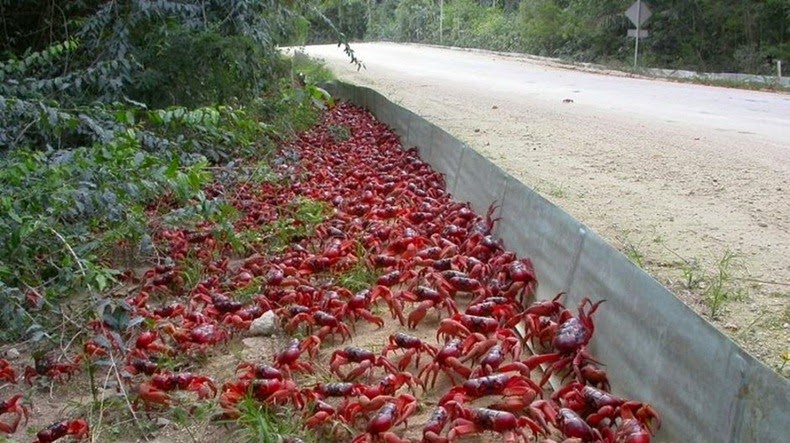
Males are the first to start the migration to the beach and later females will follow them (Fig. 1). The joined forces of the migrating red crabs form a giant red moving wave (Fig. 2).


Figure 1. Diagram of male and female Christmas Island Red Crab (Gecarcoidea natalis). Source: Australian Government.


Figure 2. A wave of Red Crabs (Gecarcoidea natalis) crossing a road. Source: Australian Government.


It takes the crabs 5-7 days to reach the sea (Fig. 3) where they breed for over a month. Following a lunar phase, females spawn 17 to 18 days after mating (Adamczewsk & Morris, 2001)


Figure 3. Red Crabs (Gecarcoidea natalis) on the beach. Source: Australian Government.


The females retreat to fresh burrows dug by males and stay there for 12-13 days to develop up to 100.000 eggs. Females release the eggs into the sea on a high pre-dawn  tide in December and January.

The eggs hatch immediately, giving rise to 4 mm larvae which will lead a planktonic life for about a month. When the larvae reach the stage called megalops with a diametre of approximately 4mm, they come back and gather on the shoreline. 

The megalops undergo a metamorphosis into air breathing tiny crabs in the water on the shoreline (Fig. 4). After a month of growth, the small crabs (6-8 mm in diametre) leave the water and head to the forest along with the adults which are on their way back home.


Figure 4. Life cycle of the Christmas Island Red Crab (Gecarcoidea natalis). Source: Australian Government.


Young crabs spend most of their time underground in burrows in the forest. If it rains they may come out to forage for leaves and other debris they find on the forest floor.

Red crabs (Gecarcoidea natalis) are diurnal and very sensitive to moisture in the air. During the dry season, the crabs retreat into their moist burrows. They close the burrow entrance with a plug made up of loose leaves and this keeps the burrows with a high humidity.


Careful drivers

The days when thousands of red crabs used to be crushed by cars on the roads are over. Nowadays people have realised the importance of these crustaceans and do their best to protect and avoid killing crabs on the roads. 

Furthermore, the Australian Government has a crew of park staff that works hard preparing for the spectacular annual migrations of the red crabs.

What do the park staff do? They set up temporary fencing to keep the crabs off the roads (Fig. 5). The crabs do the rest. The animals crawl along the fencing until they reach special crab crossings (Fig. 6). The crossings are cleaned once a year of any accumulated debris.


Figure 5. temporary fencing to keep red crabs off the roads. Source: Australian Government.


Figure 6. Crab crossing. Source: Australian Government.


Some roads are temporarily closed (Fig. 7) to help the migrating red crabs. At other points, special overpass bridges are constructed for the crabs (Fig. 8).


Figure 7. Road closed sign to help the migrating crabs. Source: Australian Government.


Figure 8. Overpass bridge for migrating crabs. Source: ABC Goldfields.


Local people also cooperate in the protection of the migrating crabs. They join the park staff with garden rakes to keep the crabs from going under the cars. The result is that more crabs reach the coast to spawn (Video 1).


           Video 1. Park staff preparing the roads for the annual Red Crabs (Gecarcoidea natalis) migration.


Red crabs, a key species in the forest


Red crabs (Gecarcoidea natalis) play an important role in the forest ecosystem. Their diet consists of fallen leaves, tree branches, flowers, fruits, seedlings and carcasses of crabs, birds, mollusks, and other dead animals. And if they live in a garden of the locals, the crabs will also eat food scraps should there be a chance.

They act as a cleaning crew and their droppings act as a fertilizer on the forest floor.Their burrowing turns over and aerates the soil. Their selective browsing on seeds and seedlings determines the structure and composition of the Christmas Island forest (Green, 1993).


Man acting as a good warden

The interaction of red crabs and humans on Christmas Island is positive for both sides. The crabs are protected and the local people get benefits from ecotourism.

This is a good example of man doing his best to live in harmony with nature. 


References

Adamczewsk A. M. & Morris S. (2001). Ecology and Behavior of Gecarcoidea natalis, the Christmas Island Red Crab, during the Annual Breeding Migration. Biol. Bull., 200: 305-320.

Green P. T. (1993). The Role of the Red Land Crabs (Gecarcoidea natalis (Pocock, 1888); Brachyura, Gecarcinidae) in Structuring Rain Forest on Christmas Island, Indian Ocean. Ph.D. Thesis, Monash University, Clayton, Victoria, Australia. 304 p.